
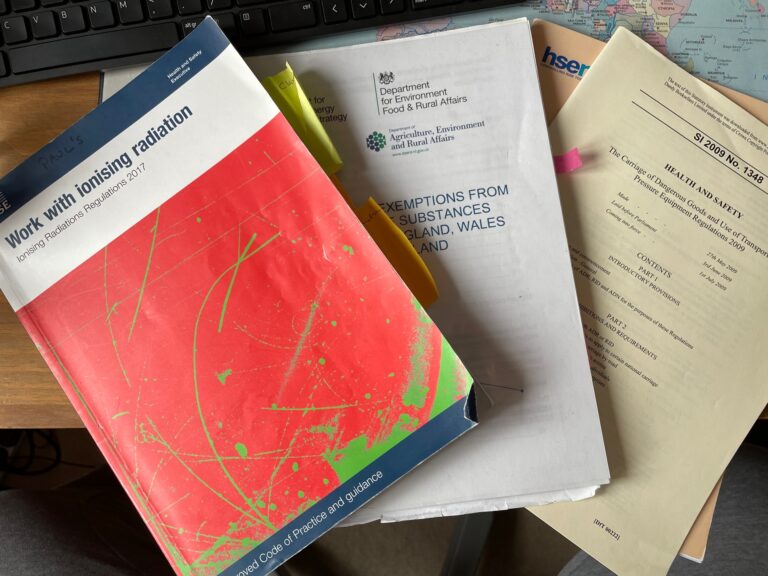
Health and Safety legislation
The Ionising Radiations Regulations 2017 (IRR17) are enforced by the Health and Safety Executive and relate to the safety of individuals who may be exposed to ionising radiation at work.
“All those involved in work or affected by work with ionising radiation…need to know how to work safely and reduce risk to their health. Training must be appropriate to the nature of the work and designed to meet the specific needs of employees.”
Work with Ionising Radiation Guidance to the Ionising Radiations Regulations 2017, Approved Code of Practice and guidance, Paragraph 262 and 263.
What is a Radiation Protection Supervisor (RPS)?
An employer must appoint a Radiation Protection Supervisor (RPS) to oversee the work and make sure local rules are followed. The RPS might also play a key role in meeting the license conditions imposed by the environment agencies* via environmental permits and certificates of registration and authorisation. The RPS should be in a position to supervise the work.
N.B. * Environment Agency (EA), Scottish Environment Protection Agency (SEPA), Natural Resources Wales (NRW).
The RPS is appointed under IRR17, which also specify that anyone appointed to the role of Radiation Protection Supervisor must be trained:
“Training is also needed where the employer arranges for employees to perform particular functions required by these Regulations”
Work with Ionising Radiation Guidance to the Ionising Radiations Regulations 2017, Approved Code of Practice and guidance, Paragraph 264.
The training must also be relevant to the work being supervised:
“The RPS should receive appropriate training under regulation 15 to carry out the task adequately. The training will need to reflect the complexity of the work being done”
Work with Ionising Radiation Guidance to the Ionising Radiations Regulations 2017, Approved Code of Practice and guidance, Paragraph 347.
An employer who is authorised by one of the UK’s environment agencies to keep radioactive material or accumulate or dispose of radioactive waste, must comply with the conditions in the authorisation. For permit holders in England and Wales, this includes the general management condition, which states:
“The operator shall manage and operate his activities using sufficient competent persons and resources”
and for permit holders in Scotland:
“You must ensure that anyone carrying out duties that may affect compliance with your authorisation is suitably trained and experienced”
The RPS will often take a lead in supervising the radioactive sources, and in helping their employer meet the authorisation conditions.
Refresher training
“Refresher training should be scheduled at regular intervals to maintain competence levels. In addition, employers should review employees capabilities and provide additional or refresher training for employees as needed”
Work with Ionising Radiation Guidance to the Ionising Radiations Regulations 2017, Approved Code of Practice and guidance, Paragraph 275.
In practice, this means that refresher training should be considered if:
- new and different radiation work begins;
- new legislation is introduced;
- the RPS has not been active in the role for a period of time; or
it has been about 3-5 years since the initial training. NB: 3 years if working occasionally as an RPS, and 5 years if working on a regular basis as RPS.
Our courses address the need for RPS and radiation awareness training in a range of workplaces.
If you are not sure or would like to discuss your specific requirments, please contact us and we would be happy to support you.
What is “RPS” training?
The RPS is a position recognised by the UK Ionising Radiations Regulations 2017 (IRR17). It is required in most cases where an employer works with ionising radiations (e.g. x-ray systems, radioactive sources and similar).
In order for the employer to appoint one or more of their employees as an RPS, the employee must attend a RPS training course. The RPS course is facilitated by a Radiation Protection Adviser (RPA).
Prior to Covid19 pandemic RPS courses would normally be held at a training venue arranged by the training provider or on client’s premises in the form of in-person training. Since the Covid19 pandemic many courses have been run online using Teams/Zoom or similar.
In the UK, in order to become an RPS the employee needs to attend a suitable training course and then be appointed in writing by their manager or other suitable person. The type of training and number of RPS positions required will depend on the nature of the work with ionising radiation and usually the employer would consult with a RPA to determine what is required.
What happens on a RPS training course?
The nature of RPS training may vary if it is being taken in person, or online e.g. via Teams / Zoom or similar. A typical RPS training course will have a little physics, biology and maths content as this is unavoidable. However, this is at a level which does not require any signifcant formal education in either subjects. It is more important that the attendee is interested and motivated to undertake the training.
Dependent on the course being provided, the course will also contain some elements of environmental, transport and of course, health and safety legislation. A typical course will generally cover:
- Basic introduction to physics of ionising radiations and typical biological effects
- Units used in radiation protection (e.g. for dose and activity)
- The basic protection principles (e.g. time, distance and shielding.)
- Contingency arrangements (i.e. what to do in an emergency)
- Radiation monitoring and dosimetry (i.e. workplace and personal monitoring)
- Typical content of local rules.
- Typical content of a risk assessment
- The role of the RPA
- The role of the RPS
- The role of the employer
- The role of other employees.
Courses will also include a short assessment, so that an “achievement” certificate can be awarded (this more valuable to the attendee and employer than a basic “attendance” certificate.